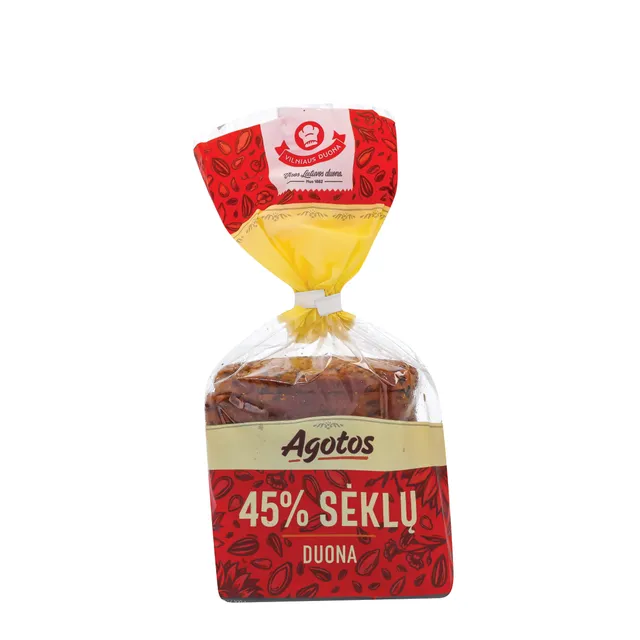
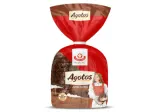
Seed bread AGOTOS 45%, 350 g
Healthier picks of the same kind
 Choux KLAIPĖDA bread with sunflower seeds, 400 g
278 kcal · 100 g
27% fewer kcal
more fruit & veg
Compare →
A
93
 Black bread with sunflower seeds JORĖ, 280g
313 kcal · 100 g
17% fewer kcal
more fruit & veg
Compare →
A
86
 Black bread with sunflower seeds AGOTA, 375g
260 kcal · 100 g
31% fewer kcal
more fruit & veg
Compare →
A
82
 Black Sliced AGOTOS Bread with Sunflower Seeds, 375 g
260 kcal · 100 g
31% fewer kcal
more fruit & veg
Compare →
A
82
| Nutrient | 100 g | 350 g |
|---|---|---|
| Energy | 1579 kJ / 379 kcal |
1327 kcal
66% RI
|
| Fat | 23 g |
81 g
115% RI
|
| of which saturates | 3,3 g |
12 g
58% RI
|
| Carbohydrate | 25 g |
88 g
34% RI
|
| of which sugars | 4,5 g |
16 g
18% RI
|
| Protein | 14 g |
49 g
98% RI
|
| Salt | 0,89 g |
3.1 g
52% RI
|
RI – reference intake for an adult (2000 kcal).
From the product label · updated 2026-10
- Salt −4
- Sugars −1
- Energy −4
- Saturates −3
- Protein +5
How this is worked out
We use the Nutri-Score method: points for energy, sugar, saturated fat and salt, less points for protein, fibre and fruit and vegetable content. Drinks, oils and cheese are judged on their own scales — otherwise olive oil would look worse than a sugary drink purely for being calorie-dense.
Shops do not publish fibre, so we treat it as zero. Whole grain and pulse products may therefore score slightly lower here than the label on the packet says.
14 ingredients · 1 additive
Tap an ingredient to see every product that contains it.
Common questions
- How many calories are in Seed bread AGOTOS 45%, 350 g?
- 100 g – 379 kcal. 1 pack (350 g) ≈ 1327 kcal.
- How much protein, fat and carbohydrate?
- Per 100 g: protein 14 g, fat 23 g, carbohydrate 25 g.
- Is Seed bread AGOTOS 45%, 350 g a healthy choice?
- Health grade D (36 of 100), from its sugar, saturated fat, salt, fibre and protein.
Added by a community member · 2026-08-31
Follow stebi.me
Label facts, in your feed every day
Where the sugar hides, which has the most protein, which yogurt is better – short comparisons worth saving.